📖
Opening Shelf & Fetching Catalog...
Connecting to For The Truth theological registry...
Connecting to For The Truth theological registry...
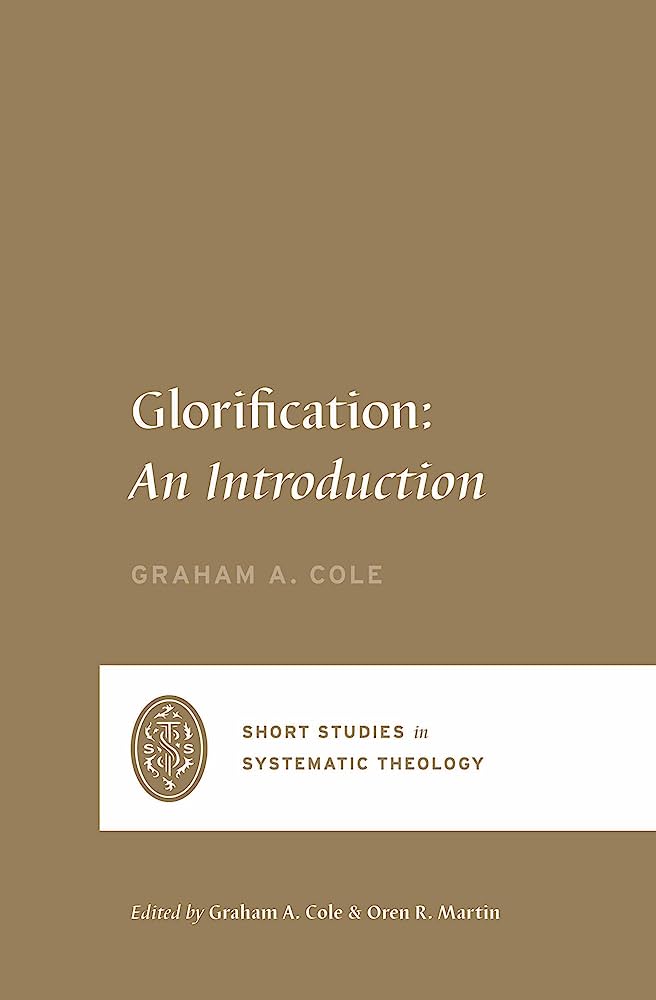
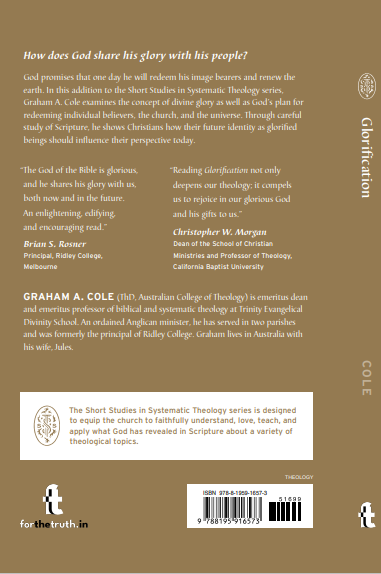
Glorification: An Introduction by Graham A. Cole explores the Christian’s ultimate hope—being fully transformed into the likeness of Christ and sharing in God’s glory. Grounded in Scripture, this encouraging book shows how God is already changing believers today and will one day complete His work through resurrection, renewal, and the new creation. A hope-filled guide to the future God has promised.
Part of the Short Studies in Systematic Theology Series
EMI from ₹42/month
Pay later available

It is easy to become pessimistic. Sin is relentless. Suffering is real. The gap between who we are and who we want to be feels impossibly wide. And the future — for the individual Christian and for the world — can seem uncertain at best and dark at worst.
But Christians have something that no amount of present difficulty can remove: a promised future. A future in which God will complete what he has begun — redeeming his image-bearers, transforming them into the likeness of his Son, and renewing the entire created order. A future in which the best is not merely hoped for but guaranteed by the resurrection of Jesus Christ and the faithfulness of the God who promises it.
Glorification: An Introduction by Graham A. Cole is a careful, Scripture-grounded, and genuinely hope-giving exploration of one of the most neglected and most important doctrines in the Christian faith — and one of the most urgently needed in the present moment. Part of the Short Studies in Systematic Theology series from Crossway, it opens up the doctrine of glorification with the theological precision and pastoral warmth that has made Cole one of the most trusted theological voices in contemporary evangelical Christianity.
As Cole notes at the outset, few books are written on the doctrine of glorification. This is a striking omission — because glorification is not a peripheral or optional element of Christian theology. It is the ultimate destination of the redemptive journey that begins with regeneration, continues through sanctification, and finds its completion in the full, final, unimaginable transformation of God's people into the likeness of his Son.
The neglect of glorification has real pastoral consequences. Christians who do not have a clear, biblically grounded vision of where they are headed — of what God has promised to make them and what he has promised to do with his creation — are more vulnerable to pessimism, discouragement, and a kind of spiritual short-sightedness that reduces Christianity to present experience rather than future hope. Cole's book addresses this directly — bringing the doctrine of glorification out of the theological shadows and placing it where it belongs: at the centre of Christian hope and at the heart of how Christians understand their present lives.
Cole begins by carefully examining the concept of divine glory — the weightiness, magnificence, and sheer otherness of who God is. This is the essential foundation for understanding glorification, because the Christian doctrine of glorification is not primarily about human achievement or personal development. It is about being drawn into the glory of God — participating in and reflecting the glory of the one in whose image human beings were made and whose likeness they are destined to bear.
This foundation shapes everything that follows. Glorification is not about humans becoming gods — it is about humans becoming fully and truly what God always intended them to be: image-bearers who reflect his glory completely, without the distortion of sin, in resurrected bodies, in a renewed creation, for eternity.
One of Cole's most important and practically useful contributions is his identification of two distinct phases of glorification:
The present phase — glorification in this life
Glorification does not begin at death or at the return of Christ. It begins now. In regeneration, in the ongoing work of the Holy Spirit, in the slow but real process of conformity to the image of Christ that is sanctification — God is already at work glorifying his people. The Christian who is being renewed in knowledge, growing in love, dying to sin, and being transformed by the renewing of the mind is already participating in the first phase of glorification.
This has profound implications for how Christians understand the present. The struggles of sanctification are not interruptions of glorification but its very process. Every act of genuine repentance, every step of faith, every small growth in Christlikeness is a participation in the glorification that will be completed at the return of Christ.
The final phase — transformation into Christlikeness
The second and ultimate phase of glorification is the final transformation that will take place at the return of Jesus Christ — the resurrection of the dead, the full conformity of God's people to the image of his Son, and the renewal of the entire created order. This is the glorification that the New Testament holds before Christians as their certain hope — the completion of everything that God began in regeneration and continued through sanctification, brought to its glorious and unimaginable fullness.
Cole carefully delineates the distinct but unified roles of the Father, Son, and Holy Spirit in the glorification process — showing how glorification is not the work of one person of the Trinity alone but the collaborative work of all three:
The Father is the one who purposed and planned glorification from eternity — whose foreknowledge, predestination, calling, and justification all find their telos in glorification (Romans 8:29–30)
The Son is both the model and the means of glorification — the firstfruits of the resurrection whose own glorification is the guarantee and pattern of ours, and whose redeeming work makes our glorification possible
The Holy Spirit is the agent of glorification in the present — the one who applies the work of Christ to believers, transforms them from one degree of glory to another (2 Corinthians 3:18), and is the guarantee of the glorification still to come
This Trinitarian framework gives the doctrine of glorification a coherence and a completeness that treatments focused on only one aspect rarely achieve — and it grounds Christian hope not in human effort or progress but in the eternal purposes and faithful work of the triune God.
One of the most important and practically useful sections of the book is Cole's exploration of how Christians' future identity as glorified beings should impact their perspective today. This is where systematic theology becomes genuinely pastoral — where the doctrine moves from the abstract to the personally transforming.
He shows how a clear, biblically grounded vision of glorification:
Graham A. Cole is Dean and Professor of Biblical and Systematic Theology at Trinity Evangelical Divinity School — one of the most respected evangelical theological institutions in the world. He is the author of numerous books including He Who Gives Life: The Doctrine of the Holy Spirit, God the Peacemaker, Faithful Theology: An Introduction (also in the Short Studies in Systematic Theology series), and Engaging with the Holy Spirit. His scholarship combines rigorous academic engagement with a genuine pastoral concern that theology should lead to deeper Christian living and worship rather than academic exercise alone. His contribution to Glorification: An Introduction reflects his particular gift for making difficult doctrines clear, grounded in Scripture, and practically transforming for ordinary Christians.
Glorification: An Introduction is part of the Short Studies in Systematic Theology series from Crossway — a collection of brief, academically rigorous, and accessible introductions to key areas of Christian theology. Other volumes available through For The Truth include Faithful Theology: An Introduction and The New Creation and the Storyline of Scripture, as well as volumes on the attributes of God, the Trinity, humanity, sin, and more.